

Structure & Principle of Pneumatic Cylinder for Automation
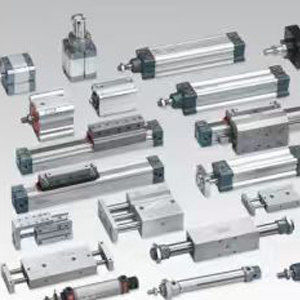
The cylinder is the core actuating component in a pneumatic system. Simply put, it converts the energy of compressed air into mechanical motion.
Its structure is not overly complicated, mainly consisting of the cylinder barrel, piston, piston rod, front and rear end covers, and sealing assemblies. Cylinder barrels are generally made of aluminum alloy, stainless steel or other metals. The inner wall undergoes precision honing, with surface roughness controlled below Ra 0.4μm, ensuring smooth movement of the piston. Sealing rings or combined seals are fitted between the piston and cylinder barrel. Driven by pressure difference, the piston moves back and forth, and the piston rod transmits this linear motion to the external load.
For practical application, cylinders are widely used in automated production lines. When the solenoid valve switches to the air intake state, compressed air at a pressure of 0.5–0.8MPa pushes the piston outward, driving the gripper to clamp the workpiece. After the operation, air is exhausted from the vent, and the piston is reset by a spring or back pressure.
Working on energy conversion based on Pascal’s principle, pneumatic cylinders feature ultra-fast response within 0.1 second and high precision with stroke error controlled at around 0.5mm, making them indispensable in industrial automation.
There is still great potential for energy-saving optimization of cylinders. For example, installing pressure sensors and intelligent valve banks can effectively reduce air consumption.


One comment
cepristech@outlook.comAuthor
Very good