

what makes a cylinder a cylinder and working principle
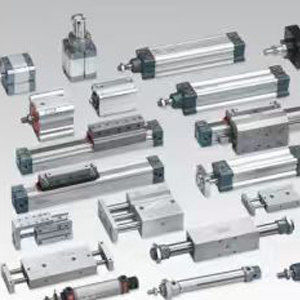
what makes a cylinder a cylinder and working principle :Amid roaring factory production lines, precision auto assembly processes, and smooth automatic door movements, an inconspicuous yet vital component works tirelessly: the air cylinder. As a core actuator converting compressed air energy into linear mechanical motion, air cylinders serve as the “muscle” of modern industrial automation.
Core Framework: Basic Structure of Air Cylinders
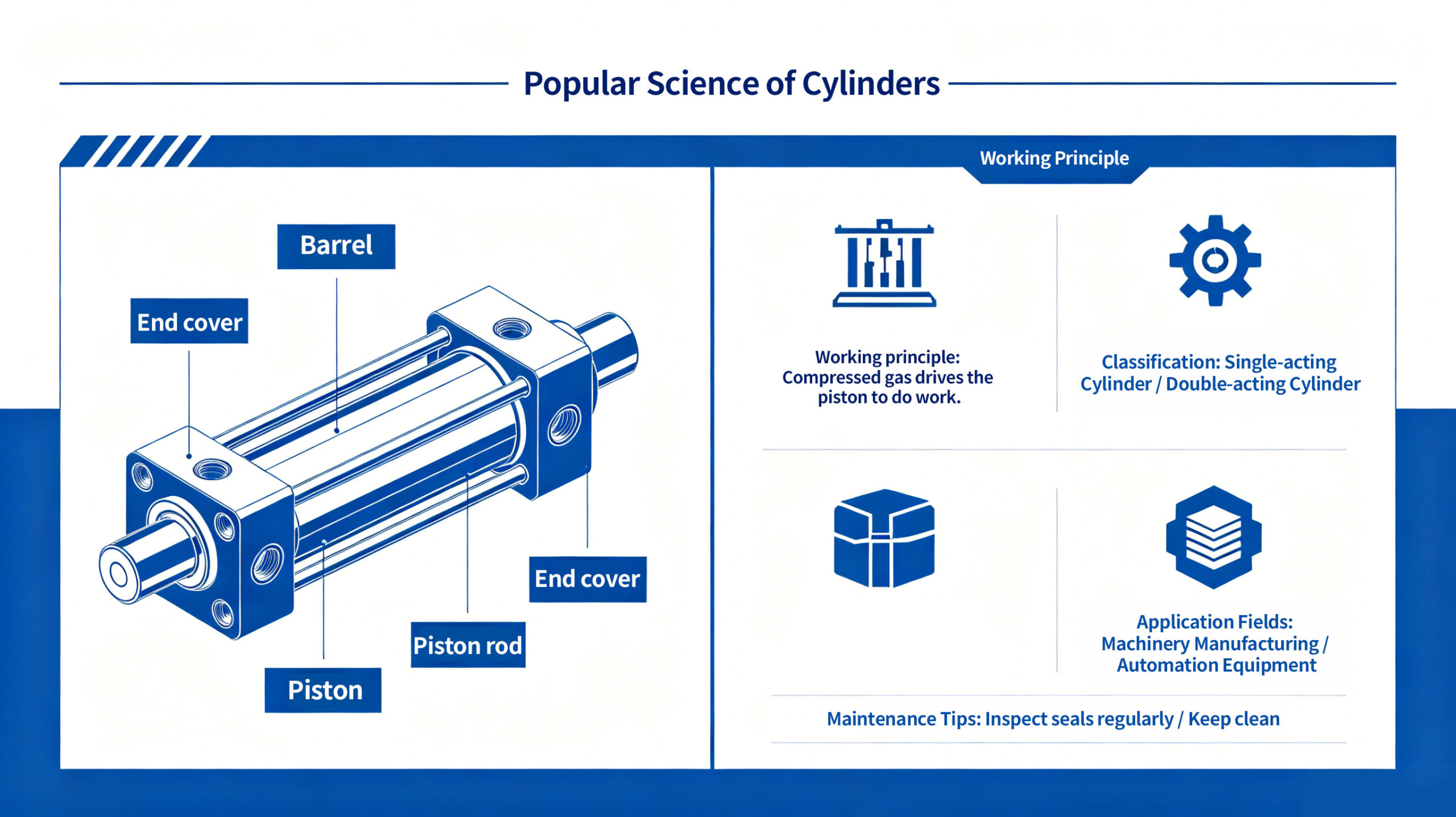
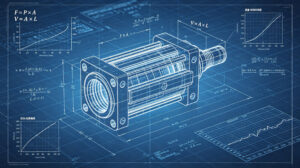
Far more than a simple metal barrel, an air cylinder relies on precisely fitted internal parts to complete energy conversion.:
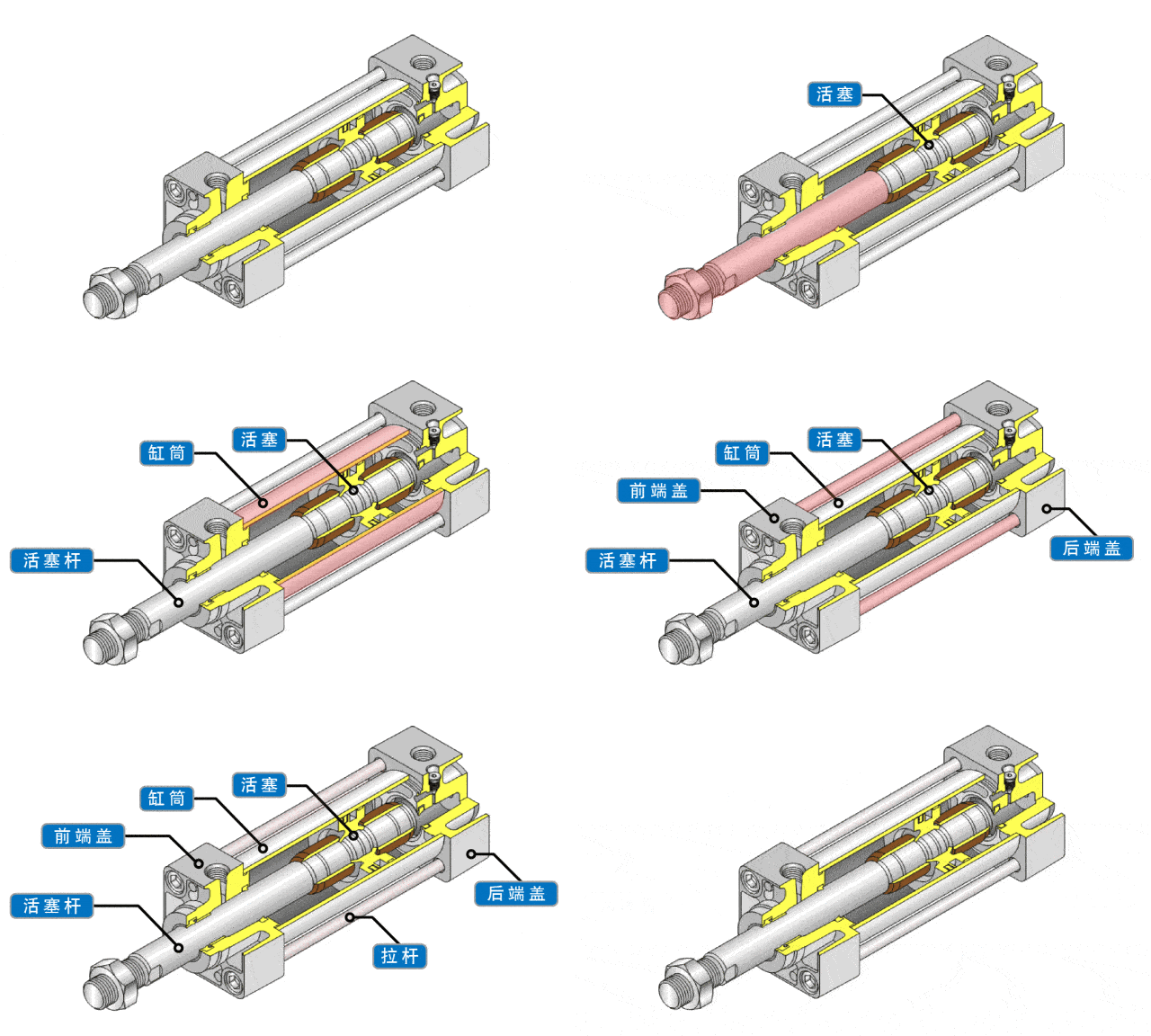
1.Cylinder Tube: the main body of an air cylinder. Mostly made of sturdy aluminum alloy or stainless steel seamless tubing with precision-finished inner bore. The smooth wear-resistant bore forms an airtight, unobstructed travel path for piston movement.
2.Piston: the heart of an air cylinder. A disc component closely fitted against the cylinder tube bore for reciprocating travel inside the barrel. Driven by pressure differential to generate push or pull force, it acts as the direct power source.
3. Piston Rod: the force transmission arm. Firmly fixed to the piston at one end and protruding out of the cylinder at the other. It transfers the piston’s linear motion to external loads, such as driving clamps, lifting platforms and opening valves.
4. Seals: the leak-proof safeguard. Installed on the piston (piston seals) and end caps (rod seals), these components are commonly made of wear-resistant NBR rubber or PU polyurethane. Critical to cylinder performance, they stop compressed air leakage between piston & barrel and piston rod & end cap to sustain stable working pressure.
5.End Caps: the front and rear ends of the cylinder. Fitted on both sides of the cylinder tube to form sealed air chambers. Air ports are machined on end caps for compressed air inlet and outlet. Guide bearings are commonly embedded inside to support the piston rod and guarantee steady linear movement.
6. Cushion Device: end-stroke shock absorber mounted at stroke terminals. As the piston travels at high speed toward the stroke end, adjustable cushion seals gradually block exhaust passages to build an air cushion ahead of the piston. The air cushion absorbs kinetic energy, effectively lowering impact and noise to protect the cylinder and connected loads.
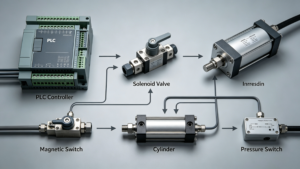
7. Accessories: including magnetic switches for piston position detection, mounting brackets and dust wiper seals that block external contaminants from entering the cylinder and damaging internal seals.
what makes a cylinder a cylinder and working principle
Power Source: Working Principle of Double-Acting Air Cylinders
The core working principle of air cylinders is to drive piston movement via pressure difference of compressed air.
- Extension Stroke:
- To extend the piston rod, compressed air flows into the front chamber of the piston through the air port on the front end cap.
- Meanwhile, the port on the rear end cap connects to the exhaust path via a directional control valve.
- Working pressure (0.4–0.8 MPa) builds up inside the front chamber and pushes the piston toward the rear, extending the piston rod outward.
- Residual air trapped in the rear chamber is squeezed out through the rear port.
2.Load Driving: The piston’s linear motion is transmitted through the robust piston rod to drive externally fitted mechanisms such as robotic arms, conveyor baffles and stamping dies for predefined operations.
- Retraction Stroke:
- To retract the piston rod, compressed air feeds into the rear chamber via the port on the rear end cap.
- At the same time, the port of the front end cap links to the exhaust route.
- Pressure accumulates in the rear chamber and pushes the piston toward the front chamber to pull back the piston rod.
- Air inside the front chamber is compressed and exhausted.
4. Reciprocating Cycle: A directional control valve such as a solenoid valve or pneumatic pilot valve continuously switches the compressed air inlet chamber and exhaust channel of the cylinder, enabling reciprocating linear motion of the piston rod.
✅ Key Point: The directional control valve acts as the cylinder’s commander, precisely regulating compressed air flow direction and the cylinder’s travel stroke.
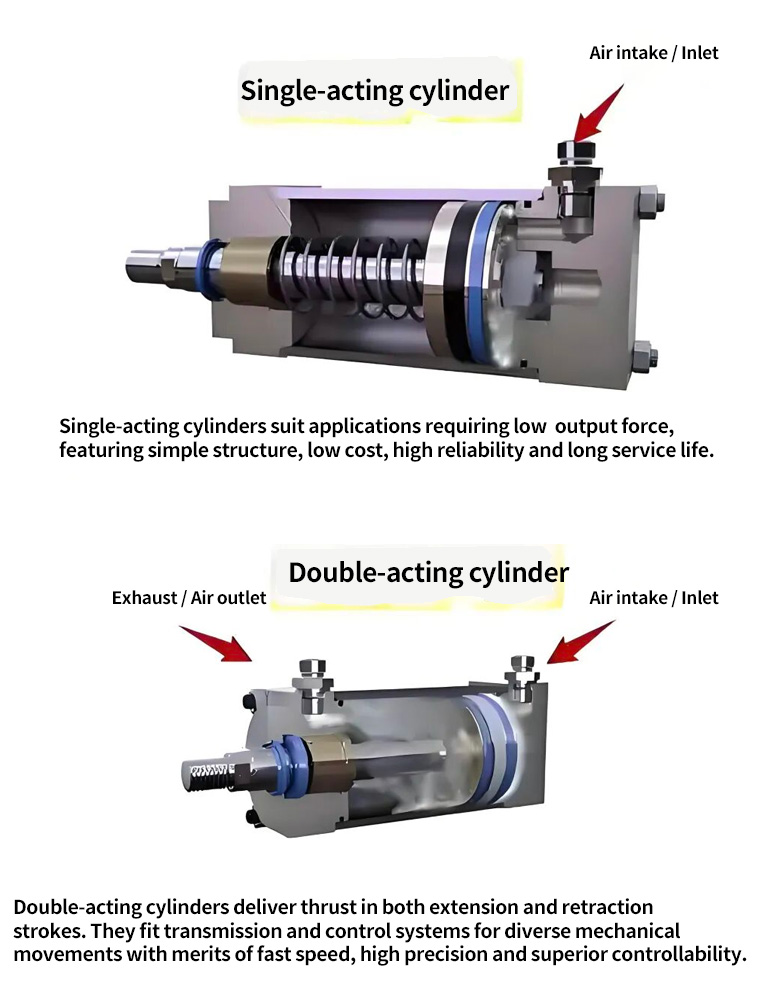
Cylinder Comparison Diagram
→ Appendix: Comparison Diagram of Single-Acting vs Double-Acting Cylinders
Ubiquitous Applications
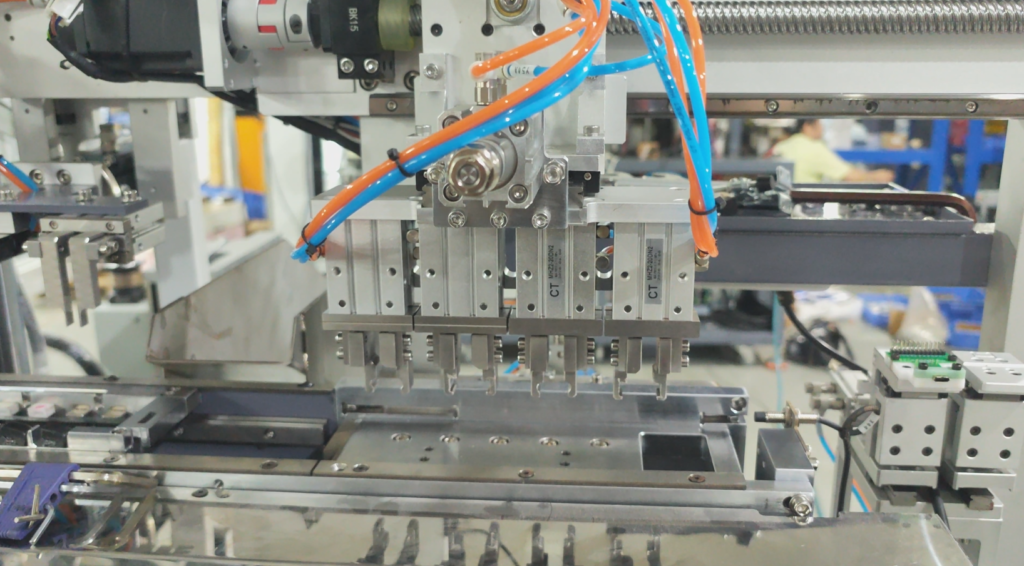
Thanks to simple construction, fast response, easy maintenance, relatively low cost and excellent explosion/fire-proof adaptability, air cylinders are widely used in:
- Automated production lines: material handling, clamping & positioning, sorting & feeding, assembling and insertion.
- Machining equipment: machine door operation, workpiece clamping, tool changing.
- Packaging machinery: carton opening & sealing, labeling, filling valve control.
- Automotive manufacturing: welding, spraying, end effector operation for assembly robots.
- Food & pharmaceutical industry: conveying and valve control in hygienic working conditions.
- Construction machinery: brake control and partial suspension adjustment.
Selection and Maintenance
- Type Selection: Besides the widely used double-acting cylinders driven by compressed air on both strokes, single-acting cylinders return via spring after air-powered extension. Select proper bore size and stroke according to load weight, speed requirement, travel length and mounting space.
- Sealing Performance Matters: Seals determine cylinder service life and working efficiency. Feeding clean, dry compressed air and performing regular lubrication maintenance effectively prolong seal lifespan.
- Cushion Adjustment: Adjust end cushion devices properly based on actual load and running speed for smooth stopping and reduced mechanical impact.
Case studies available on LinkedIn
https://www.linkedin.com/in/%E5%93%81%E6%A3%AE-%E5%BD%AD-79818b411
Case studies available on Facebook
https://www.facebook.com/share/14auKTNBnzu/?mibextid=wwXIfr
what makes a cylinder a cylinder and working principle #principle #cylinder #


Add comment