

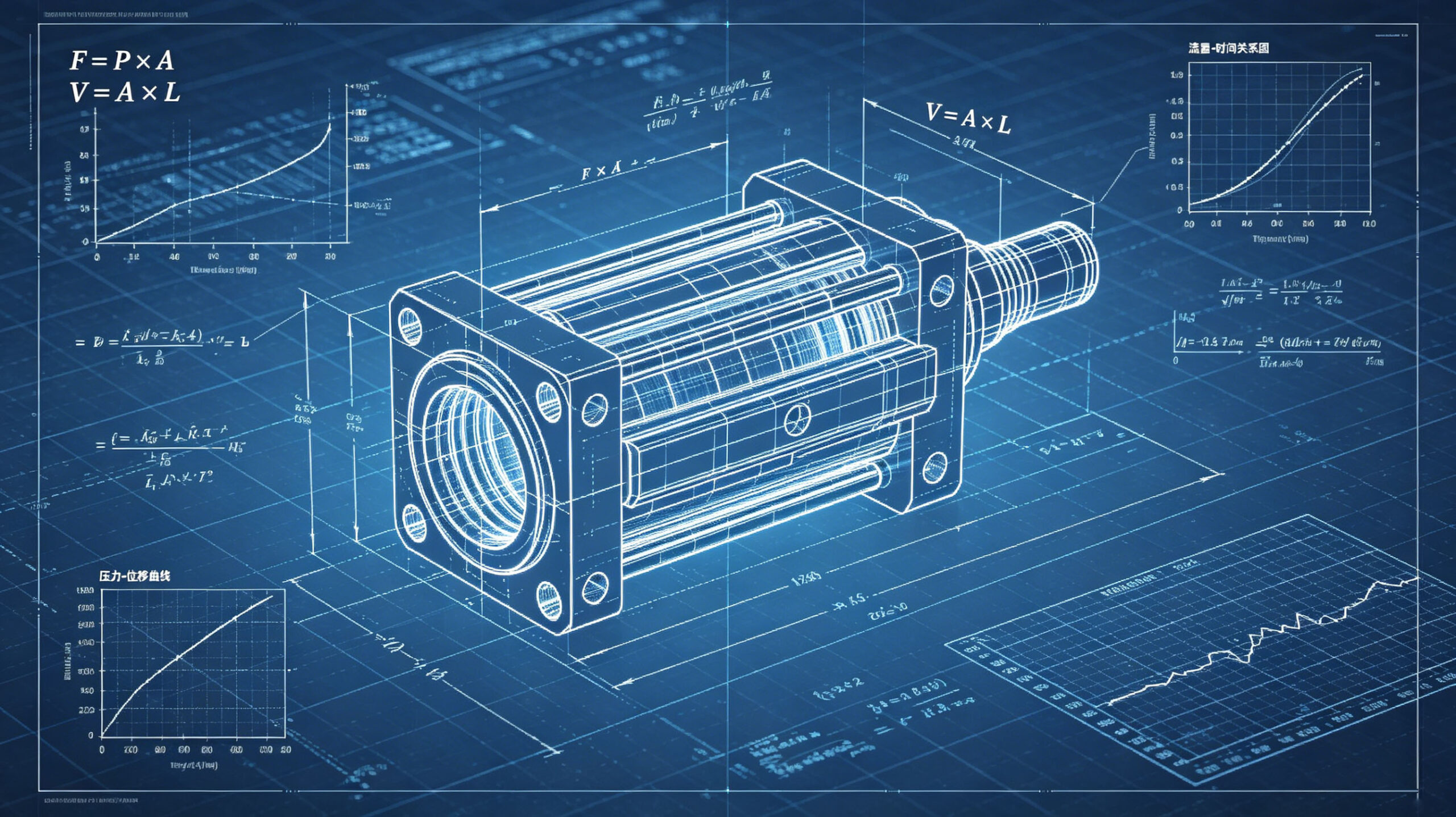
This section covers Cylinders selection data calculation.
Cylinders Selection Calculation Guide
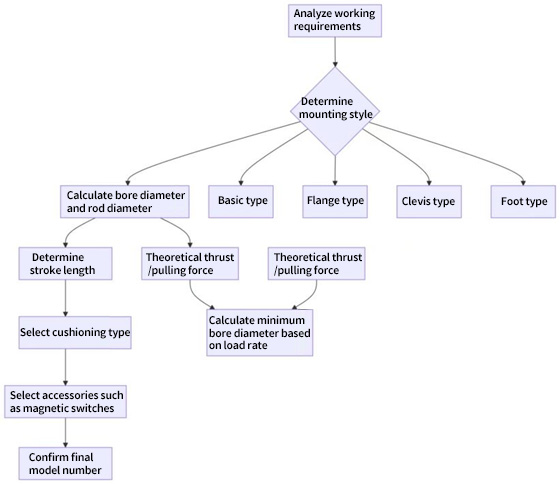
Step 1: Analyze Operating Requirements
This is the basis of selection. Please confirm the items below:
- Load mass: Weight of the object to be pushed or pulled.
- Motion mode: Horizontal push/pull, vertical lifting or inclined movement?
- Installation space constraints: Maximum allowable length, diameter and stroke of the cylinder.
- Operating speed: Moving speed of the cylinder rod (Unit: mm/s).
- Operating frequency: Number of cylinder cycles per minute. This affects the service life and heat generation of the cylinder.
- 6. Operating environment: – Temperature: Normal, high or low temperature. *Medium: Check for corrosive conditions (e.g. seawater, acid mist) and oil *free requirements (e.g. food, pharmaceutical industries). *Protection level: Presence of dust, moisture, cutting fluid, etc.
Step 2: Determine Cylinder Type and Mounting Style
1.Cylinder Type
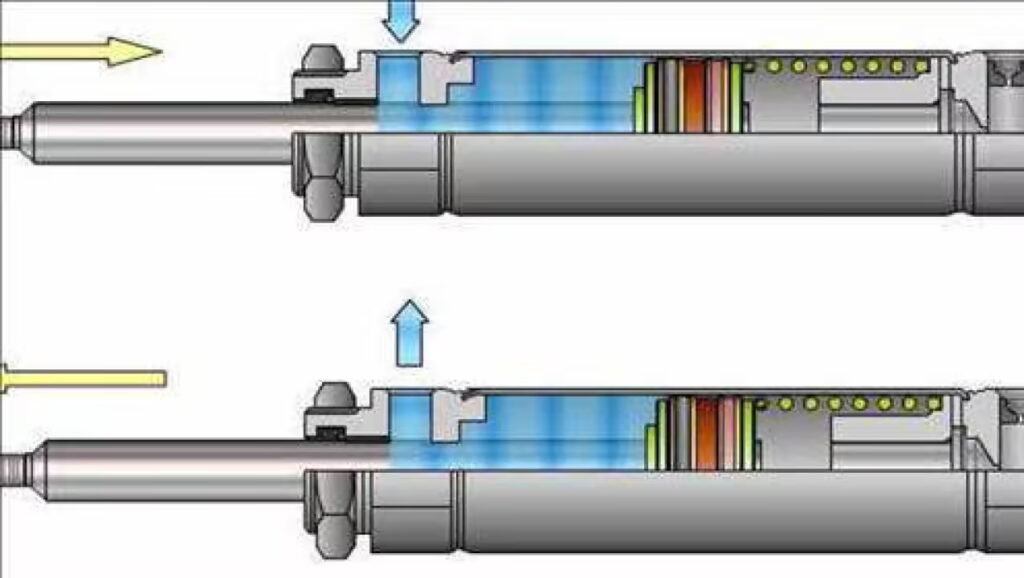
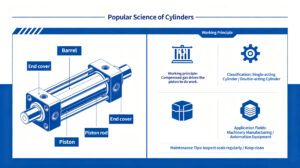
Single-acting cylinder: Equipped with one air port. It extends or retracts by air pressure and resets via spring force. Featuring simple structure and low air consumption, it delivers asymmetrical force and has limited stroke. Application: One-way force scenarios such as clamping, ejector pins and door opening.
Double-acting cylinder: Fitted with two air ports. Extension and retraction are realized by alternating air supply. It provides large output force and wide stroke range, being the most widely used type. Application: Most pushing, pulling and lifting operations.
2.Mounting Style
Mounting style determines how the cylinder is fixed and its force bearing condition.
*Basic type: No built-in mounting bracket; extra mounting accessories need to be customized.
*Front flange: Flange mounted on the cylinder head. Mounting bolts bear tension with favorable force conditions, which is the most commonly used design.
*Rear flange: Flange mounted on the rod end.
*Single clevis: Allows swinging around the pin shaft, ideal for applications where the cylinder swings during operation.
*Double clevis: Offers higher mounting stability.
*Axial foot: The foot is aligned coaxially with the cylinder.
*Tangential foot: Feet are installed on both sides of the cylinder.
Selection Principle: The mounting style shall ensure cylinder forces act along the axial direction as much as possible. Avoid lateral or radial loads, otherwise the service life of the cylinder will be greatly reduced.
Step 3: Calculate Bore Diameter and Piston Rod Diameter (Core Calculation)
1.Theoretical Output Force Calculation
First, calculate the required theoretical thrust or pull force based on the load and motion status.
Thrust (F₁): Force generated when the cylinder extends.
F1(N)=Cylinder cross-sectional area (A1)×Operating pressure (P)
or F1≈0.785×D2×P
(D: Bore diameter, unit: mm; P: Operating pressure, unit: MPa)
Pull Force (F₂): Force generated when the cylinder retracts. The pull force is smaller than the thrust due to the area occupied by the piston rod.
F2(N)=(Cylinder cross-sectional area−Piston rod cross-sectional area)×Operating pressure (P)
or F2≈0.785×(D2−d2)×P
(d: Piston rod diameter, unit: mm)
2.Actual Output Force and Load Factor
The actual output force of the cylinder must exceed the force required to overcome the load. A load factor (η) is adopted to account for friction, inertia force and other factors.
Actual available force = Theoretical output force × Load factor
Selection rules for load factor (η)
- Static load (clamping, pressing): η ≤ 80%
- Dynamic load (horizontal movement): η ≤ 60%
- Dynamic load (vertical movement): η ≤ 50%
- High-speed & high-frequency operation: η ≤ 30%
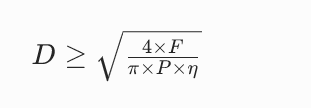
Formula for minimum required bore diameter
D: Bore diameter (mm)
F: Required thrust or pull force (N)
P: Operating pressure (MPa) η: Load factor
Example
A 100 kg object needs to be pushed horizontally. Operating pressure = 0.6 MPa, load factor = 60%.
Required force:
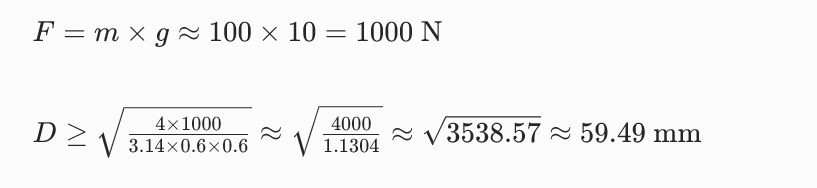
In accordance with standard bore sizes (32, 40, 50, 63, 80, 100), select a cylinder with a bore diameter of 63 mm.
3.Piston Rod Diameter
– Standard cylinders feature a fixed ratio between piston rod diameter and bore diameter (e.g. Φ32/Φ16, Φ63/Φ20).
– Cylinders Selection Calculation Guide For long strokes and compressive loads (such as vertical lifting), check the rod buckling resistance to avoid bending. If stability is insufficient, select a cylinder with a larger rod diameter, or use a reinforced rod / twin-rod cylinder.
Step 4: Determine Stroke
Stroke refers to the travel length of the piston rod.
– Determine the stroke according to actual working requirements.
– Avoid excessive stroke length, as it will reduce rod stability. For long-stroke applications, extended-stroke or guided rod cylinders are recommended.
– Prioritize standard strokes. Non-standard strokes entail higher costs and longer lead times.
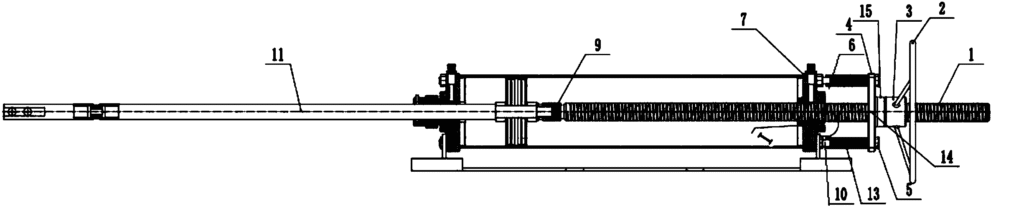
Step 5: Select Cushioning Type
Cylinders require cushioning at the end of stroke to absorb impact, protect equipment and reduce noise.
No cushion: Suitable for low speed and light load conditions.
Fixed cushion: Equipped with built-in cushioning components (orifice and cushion plunger) on cylinder heads and ends, which is the standard configuration.
Adjustable cushion: Cushioning speed can be adjusted via screws for wider applicability.
Hydraulic shock absorber: Extra installation is required for high-speed and heavy-duty scenarios, delivering the best cushioning performance.
Step 6: Select Accessories and Other Options
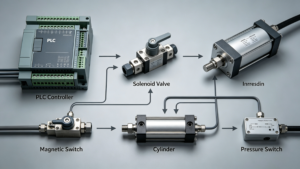
Magnetic switch: Detects piston position for automatic control, a standard component for automated equipment.
Stroke adjustment: Choose whether front or rear adjustable stroke is required.
Lubrication:
Lubricated cylinder: Requires connection to an oil mistor for lubrication.
Oil-free cylinder: Adopts self-lubricating materials with no oil supply needed. It is the mainstream choice nowadays, especially for oil-free working environments.
Protection
Protective cover: Blocks dust and cutting chips for harsh working conditions.
Cylinder tie rod: Made of stainless steel, suitable for corrosive environments.
Speed control valve: Used to adjust the extension and retraction speed of the cylinder.

Cylinders Selection Calculation Guide


Add comment