

G‑Thread (BSPP) Pneumatic Fittings: Working Principle, Advantages & Correct Installation Guide
Why G‑Thread Is Better for Pneumatic Mass‑Production Assembly
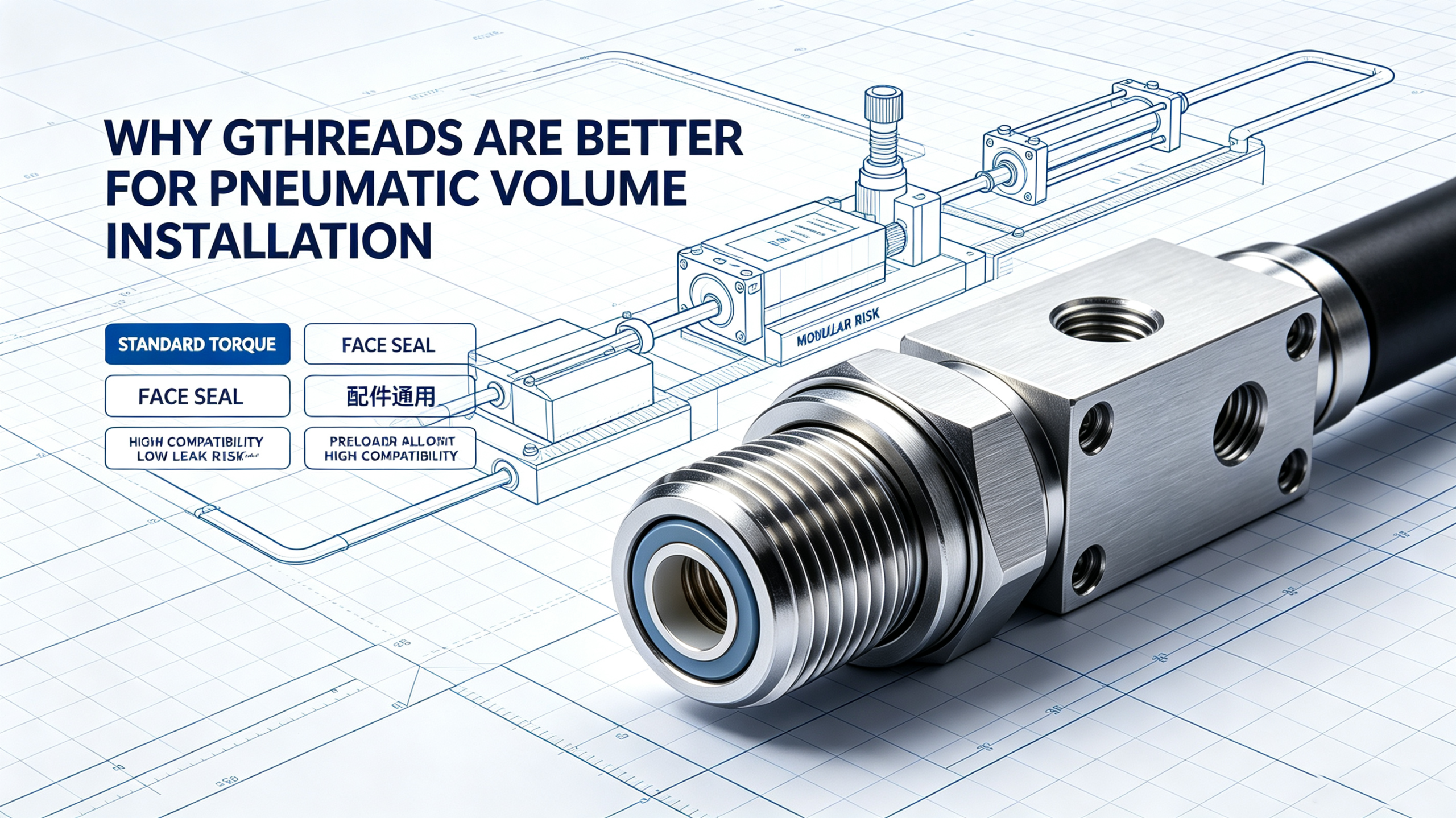
G threads cannot achieve sealing through their thread profile.
G threads (GB/T7307, 55° non‑sealing parallel pipe threads) feature constant‑diameter straight thread forms. Most importantly, they produce no wedge‑fit interference effect from a 1:16 taper. As a result, tightening generates only axial clamping force. Meanwhile, tiny helical gaps remain between thread flanks, so compressed air leaks readily along these openings. Furthermore, national standard specifications clearly define the functional scope of G threads; specifically, these threads serve mechanical connection purposes only. Accordingly, users must achieve sealing performance through non‑thread face‑sealing structures, such as flat gaskets, O‑rings and combined sealing washers.
Five Reasons Why the Pneumatic Industry Widely Uses G Threads, Despite Knowing They Do Not Self‑Seal
1.It delivers excellent assembly consistency and controllable tightening depth, and eliminates damage caused by over‑tightening.
In comparison, compressed face gaskets position G parallel threads. These fittings feature fully fixed insertion depth and support assembly with standardized torque values. Mass‑produced valve manifolds and cylinder connectors keep consistent fitting heights, so hardware stays free of tilted fittings and stripped valve threads for high fault tolerance during large‑scale pneumatic assembly.
2.It allows repeated assembly and disassembly and delivers far longer thread service life than taper sealing threads.
Taper threads squeeze and wear their thread profile with every mount‑demount cycle. Sealing performance fails completely after multiple disassembly operations. For G threads, threads bear mechanical force but take no part in sealing. Repeated tightening only compresses the face‑mounted rubber gasket, so the threads sustain almost no wear. This makes G threads ideal for frequent maintenance and air‑tube connector replacement on pneumatic components.
3.It delivers better stability against vibration and pressure fluctuation with lower risk of air leakage.
Pneumatic systems face shock from air compressor start‑stop cycles, pressure pulsation during cylinder direction switching, and overall machine vibration.
NPT/R taper threads create seals through metal thread interference. Tiny displacement of thread profiles under vibration triggers minor air leaks.
For G threads, face‑mounted elastic gaskets take full sealing responsibility. These gaskets absorb vibration and pressure shocks. Sealing reliability does not depend on thread‑fit precision. G‑thread fittings show far lower leakage probability in long‑term operation than taper‑thread joints and greatly cut wasted compressed‑air energy consumption.
4.It fits valve bodies of diverse materials and resists tapping‑related damage.
Pneumatic solenoid valves and valve manifolds mostly adopt die‑cast aluminum alloy; some use plastic valve bodies. For taper threads, forced tightening readily rips internal tapped holes. G threads apply only axial compressive force. They treat aluminum and engineering‑plastic substrates more gently and lower scrap rates for valve bodies.
5.It follows internationally‑accepted standards and delivers outstanding part compatibility.
G threads (BSPP) serve as the common interface for European pneumatic brands including Festo, AirTAC and SMC, as well as China’s domestic pneumatic industry. Full‑size components such as G1/4, G1/8, G3/8 fittings, push‑in connectors, blanking plugs and adaptors enjoy mature mass production. They carry low procurement costs and offer maximum interchangeability. By comparison, NPT American‑standard threads show poor compatibility within China’s domestic pneumatic‑parts supply chain.
Question 2: Can PTFE tape on G1/4 threads achieve sealing under 0.6 MPa air pressure?
1.Conclusion: Under static conditions without heavy vibration, the joint can reliably contain 0.6 MPa (6 bar) compressed air.
0.6 MPa falls within the standard low‑pressure range for pneumatic systems. PTFE tape fills gaps inside the G‑thread pair and temporarily blocks helical leakage paths along threads. Joints hold pressure well in static pressure‑holding tests with barely any air leakage. Many field technicians use this method for on‑site emergency repairs.
2.Notes (Not Recommended as an Official Solution)
(1) It goes against the original design intent of national standards and counts as an unapproved alternative solution.
GB/T7307 mandates face gaskets for G‑thread sealing. PTFE tape only fills thread gaps as a remedial measure, and it is not an intentionally‑designed sealing surface.
(2) Slow leakage tends to occur later under vibrating working conditions.
Frequent movements of machine‑tool and production‑line cylinders generate continuous vibration. PTFE tape creeps, compacts and shifts gradually. Minor air leaks will most likely emerge within weeks or months. This keeps air compressors running non‑stop and raises energy consumption.
(3) It may trigger assembly failures.
Over‑wrapped PTFE tape squeezes fragments into the air circuit during tightening. These debris clog solenoid‑valve spools and small orifices inside flow‑control valves. Consequently, cylinders stutter and valves jam. Excess PTFE tape also prevents full compression of face gaskets and brings dual‑mode sealing failure.
(4) Re‑use is practically impossible after disassembly.
PTFE tape hardens inside thread crevices and creates troublesome cleanup during disassembly. Re‑wrapped tape delivers greatly reduced sealing performance.
3.Correct Standard Practice (Pneumatic‑Industry Standard Installation)
For male fittings with pre‑fitted O‑rings or PTFE‑coated combined sealing washers: screw the fitting into the G female thread of the valve body. Sealing comes from compressed face‑mounted O‑rings. Do not wrap any tape onto threads.
If the fitting carries no built‑in seal, install copper flat gaskets, rubber flat gaskets or PTFE gaskets against the fitting flange face.
Only for emergency repairs on worn or slightly stripped old threads: apply a thin clockwise layer of PTFE tape as a temporary fix. Replace it with face‑gasket sealing during major equipment overhaul.
Quick Summary
G threads achieve sealing via face gaskets instead of thread engagement. They bring controllable torque, repeated disassembly‑assembly capability, good vibration resistance, protection for aluminum‑alloy valve bodies and broad component compatibility. They represent the optimal engineering choice for pneumatic systems.
Wrapping PTFE tape on G1/4 threads holds seal at 0.6 MPa under static conditions, yet slow leakage occurs under vibration. Reserve this method only for emergencies. Use face gaskets or O‑rings for long‑term reliable performance.
Why G‑Thread Is Better for Pneumatic Mass‑Production Assembly




Add comment