

Pneumatic vs Hydraulic: Selecting the Right Power Source for Your Application
Table of Contents
- Core Differences
- When speed and simplicity are critical
- When force and control are critical
- Cost, Maintenance and Reliability
- Hybrid and Intelligent‑Control Trends
- Application‑Specific Scenarios Determine the Winner
Within the hardware‑tool and industrial‑power sectors, attention is often drawn to the agility of hand tools and the convenience of power tools. Yet another pair of “invisible forces” that underpin heavy‑duty operations and precision control are frequently overlooked: pneumatic and hydraulic systems, these two power sources leverage their distinct strengths to integrate deeply into industrial production, spanning from mining sites to automated assembly lines in manufacturing workshops.
Core Differences
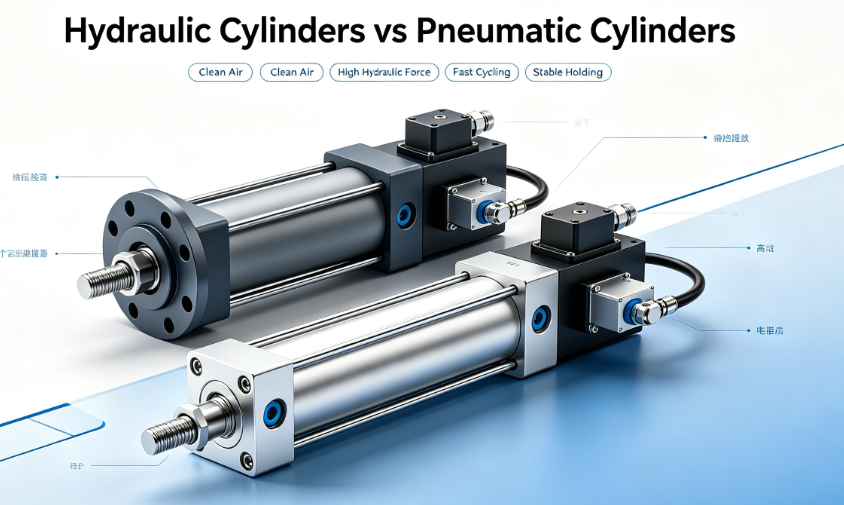
Every decision starts with the working medium. Pneumatic systems use compressed air, which is lightweight, clean and readily available, with typical operating pressure ranging from 80 to 100 psi. Hydraulic circuits rely on oil or specialized liquids, delivering pressure between 1,000 and 5,000 psi. Heavy‑duty cranes can even exceed 10,000 psi. Since liquids are far less compressible than gases, hydraulic actuators can generate up to ten times the force of pneumatic actuators of the same physical size
When speed and simplicity are critical
Pneumatic cylinders accelerate rapidly, as the working medium flows quickly through narrow pipelines and system components weigh less than equivalent hydraulic counterparts. Actuators can complete a cycle within milliseconds, making them suitable for pick‑and‑place robots, high‑volume packaging lines and compact laboratory automation equipment. Exhaust handling is straightforward: once the stroke finishes, discharged air is released directly into the atmosphere. This simplicity translates into less leak‑related cleanup work and lower installation costs.
However, compressed air also carries hidden costs. Compressors must run continuously, converting up to 30% of input power into heat. Even tiny leaks translate into substantial money waste. For precision‑positioning tasks, the compressibility of air may cause overshoot or bounce unless additional damping devices are installed.
When force and control are critical
Hydraulic systems excel when loads must remain perfectly stationary. Driven by incompressible fluid to move pistons, hydraulic machines deliver precise, repeatable force and hold position without drift. This stability is vital for injection‑mold clamps, earth‑moving buckets, and offshore winches built to withstand storm conditions. Energy audits show that properly tuned hydraulic systems can convert over 80 % of pump power into useful work, provided filters stay clean and hoses remain tightly secured.
Nevertheless, these force‑transferring fluids also create potential hazards. Leaks can contaminate food‑grade production lines or pharmaceutical clean‑rooms. Hot oil may cause scald injuries, and certain synthetic oils can ignite if splashed onto hot surfaces. Maintenance crews need spill‑response kits, dedicated sealing components, and rigorous inspection schedules.
Cost, Maintenance and Reliability
Pneumatic systems hold an edge in upfront hardware costs. For the same stroke length, smaller cylinders and low‑cost valves bring initial spending roughly 40 % lower than hydraulic alternatives. This advantage narrows over time, however. In light‑industry plants, air compressors rank among high‑energy‑consuming equipment, accounting for nearly 10 % of total electricity bills. Hydraulic systems carry higher maintenance costs, yet their seals deliver longer service life and hydraulic fluid can be reused. For many heavy‑duty equipment applications, cost parity is reached after three years of operation.
System uptime data shows that well‑maintained hydraulic machines achieve up to 98 % availability. By contrast, availability of ageing pneumatic piping drops below 92 % once leakages exceed 10 % of compressor output.
Hybrid and Intelligent‑Control Trends
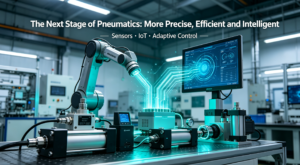
Few modern‑day machines operate under purely extreme conditions. Instead, many designers now combine electronically controlled proportional valves with hydraulic cylinders to deliver electronic‑control precision while retaining high power output. On the other hand, sensor‑rich pneumatic grippers can monitor pressure and flow rate, feeding data back to programmable logic controllers (PLCs) to adjust stroke speeds for complex pick‑and‑place patterns. Visitors can spot these hybrid systems everywhere at hydraulic‑tool exhibitions, a reflection of their growing importance within modern factory layouts.
Application‑Specific Scenarios Determine the Winner
Dental drills, micro‑assembly robotic arms and clean‑room wafer‑handling equipment rely on the cleanliness and flexibility of air. Quarry lifts, offshore winches and stadium‑roof lifting devices count on the brute force of hydraulic oil. Between these two extremes, hybrid approaches often dominate: pneumatic pilot valves trigger hydraulic clamps; electro‑hydraulic pumps cut no‑load losses; compressed‑air boosters deliver peak‑flow output only when sensors detect high demand. Technologies keep advancing, yet the application remains the deciding factor.
Pneumatic vs Hydraulic: Selecting the Right Power Source for Your Application


Add comment