

Common Faults and Solutions for Ball Screws after Assembly
Ball Screw Selection & Troubleshooting Ball Screw Installation and Troubleshooting of Common Post-installation Issues
1.Precautions Before Installation
- Ensure the flatness and rigidity of the mounting surface before installation.
- Keep the mating surfaces of the ball screw, screw nut and bearing housing clean, free of burrs and foreign debris.
- Take care not to damage the raceway of the screw nut when transporting the ball screw back and forth.
- Verify the compatibility of the support end, fixed end and ball screw prior to installation.
2.Three Common Installation Methods
A.Fixed-Supported End Configuration (See figure below)
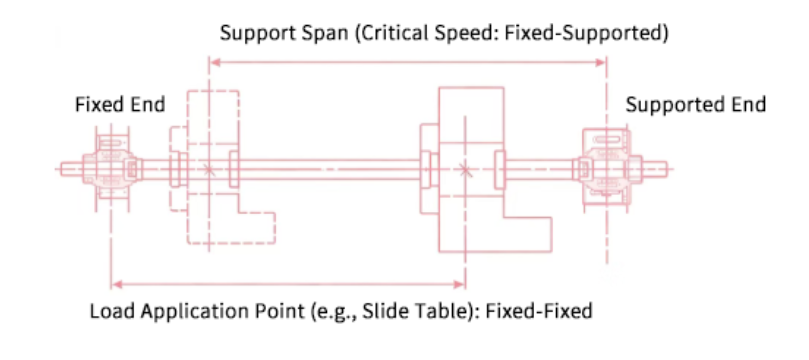
This mounting configuration is relatively common, suitable for medium-to-high speed motion, and can also be adopted for applications requiring medium-to-high precision. Its support units at both ends typically adopt a fixed-end plus supported-end combination.
B.Fixed-Fixed Configuration (See figure below)
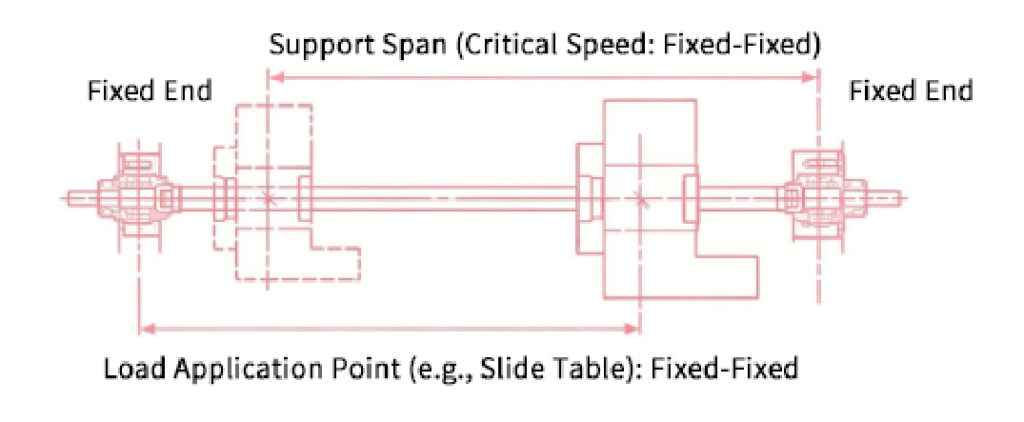
This mounting configuration suits medium-speed rotation and high-precision applications. It delivers superior rigidity and is ideal for scenarios demanding strict axial positioning.
C.Fixed-Free Configuration (See figure below)
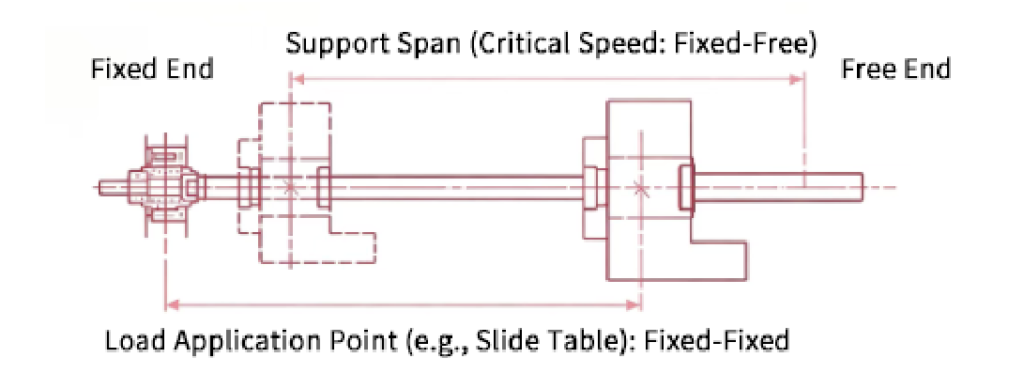
This mounting configuration is suitable for low-speed rotation and applications with relatively short screw shafts. It features a comparatively simple structure. Since one end remains unsecured, its accuracy is relatively lower.
3.Common Post-installation Issues
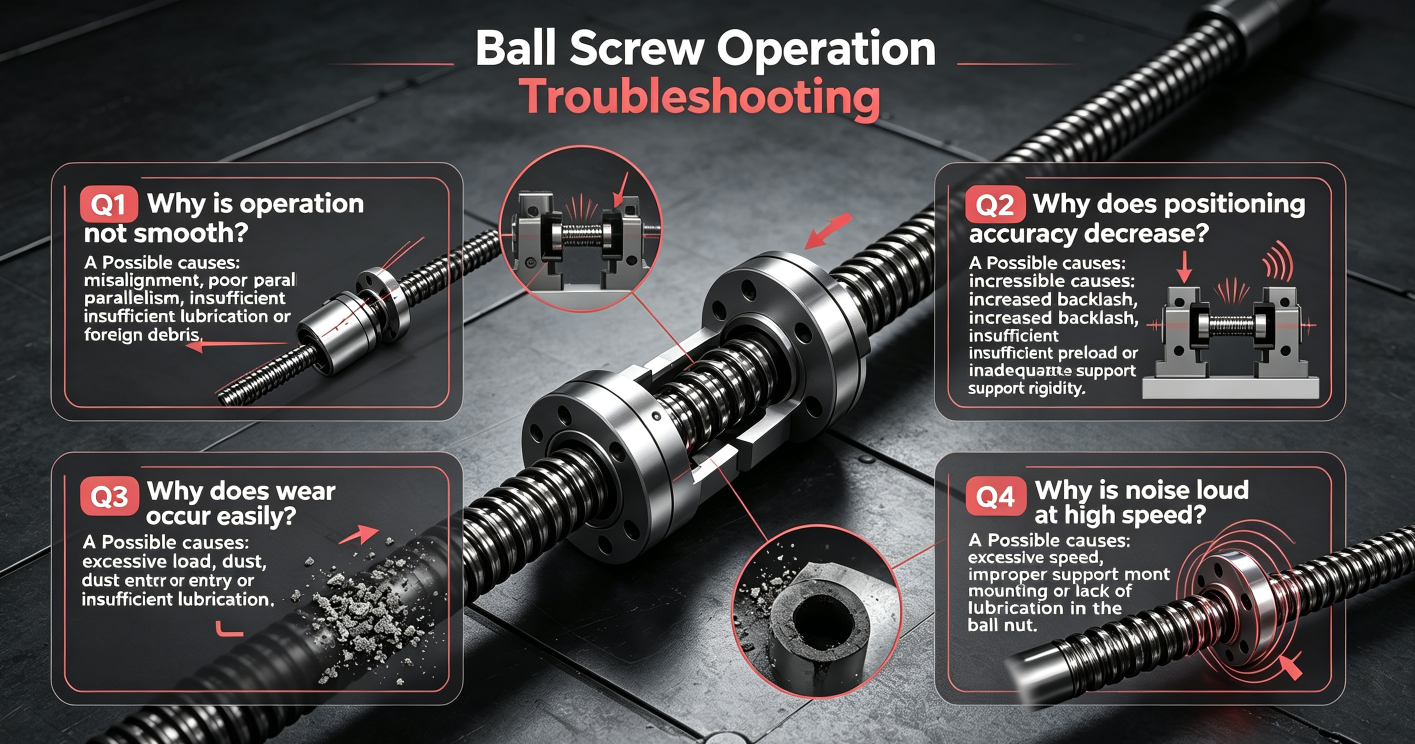
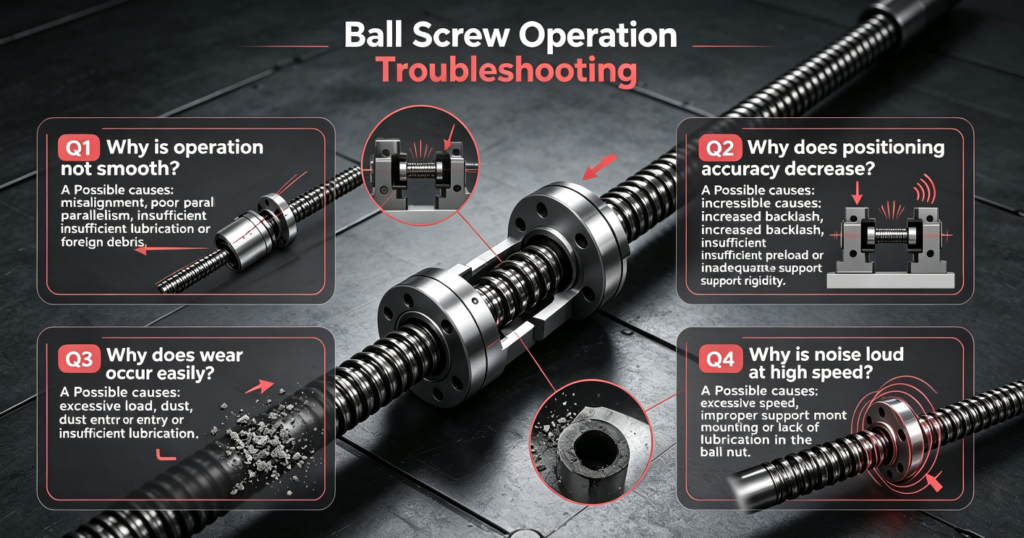
1.Why does the operation feel unsmooth after installation?
Answer: This may be caused by shaft misalignment, poor parallelism, insufficient lubrication, or foreign debris on the ball screw surface or inside the ball nut.
2.Why is the repeat positioning accuracy of the ball screw poor, and it fails to return to the same position after multiple runs?
Answer: This may be caused by increased backlash, insufficient preload, or inadequate rigidity of the supports at both ends of the ball screw.
3.Why is there severe wear on the ball screw or ball nut?
Answer: This may result from insufficient lubrication for the ball nut, dust ingress, excessive load, or shaft misalignment during installation.
4.Why does the ball screw generate loud noise during high-speed operation?
Answer: This may be caused by excessive rotating speed, improper mounting configuration of supports, or failure to lubricate the ball nut.
We provide a complete application workflow for your reference.
- The motor provides rotational power.
- The coupling transmits the power generated by the motor.
- The ball screw converts rotary motion into linear motion.
- The linear guide provides guidance.
- The worktable executes the required movements.

Ball Screw Selection & Troubleshooting Brief Summary
The ball screw does not provide power. Power is supplied by the motor; the screw only efficiently and accurately converts rotary motion into linear motion.
A ball screw consists of a screw shaft, ball nut, steel balls, ball circulation components and end sealing components.
Ball screw selection cannot be based on dimensions alone. Load, stroke, speed, accuracy, available space and operating environment must all be considered together.
The correct mounting configuration of the ball screw enables a balance among rotational speed, rigidity, accuracy and service life.
The three common mounting types for ball screws are: fixed-supported, fixed-fixed, and fixed-free.
Lastly, ball screws are most likely adopted in all equipment requiring stable feed, precise positioning and smooth lifting.



Add comment