

Comprehensive Guide to Pneumatic Actuators | Become an Expert Quickly
Comprehensive Guide to Pneumatic Actuators | Become an Expert in Seconds
A pneumatic actuator, also known as pneumatic head, pneumatic valve drive device or pneumatic valve actuator, is a mechanical device that uses compressed air as power source to drive the opening, closing and regulation of various valves such as air dampers and butterfly valves.
Pneumatic actuators are widely applied in multiple industries, including boiler air damper regulation, HVAC ventilation systems, oil and gas pipelines, chemical processing, and environmental protection equipment.
Working Principle
1.Double Acting Pneumatic Actuator
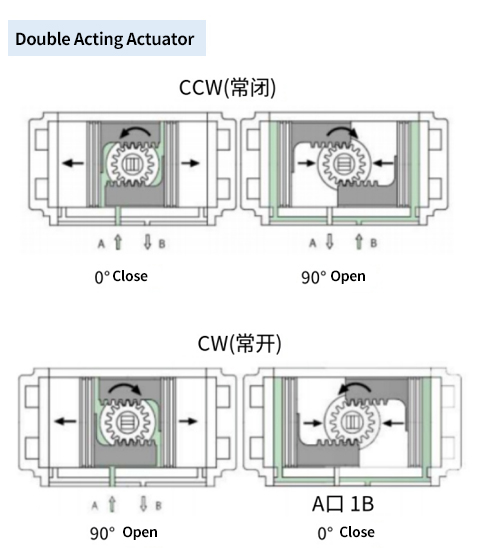
1· Compressed air enters through port A and pushes the dual pistons outward. The racks on the pistons drive the gear shaft to rotate, which opens the valve.
· Compressed air enters through port B and pushes the dual pistons inward. The gear shaft rotates reversely, which closes the valve.
2.Single Acting Pneumatic Actuator
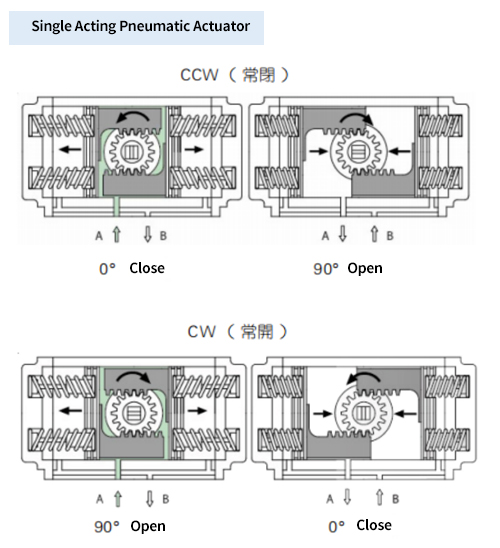
· Air pressurization: Air pressure overcomes spring force to open the valve.
· Air exhaust: The spring automatically resets to close the valve.
General Composition
2.Cylinder Pneumatic Actuator
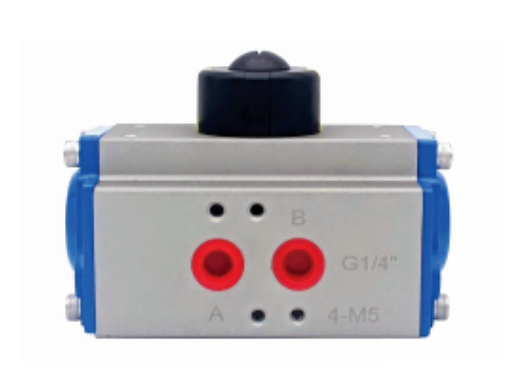
When compressed air enters from port A, it pushes the dual pistons to move toward both ends. The rack on the pistons drives the gear shaft to rotate, opening the valve.
When compressed air enters from port B, it pushes the dual pistons to move inward. The gear shaft rotates in the reverse direction, closing the valve.
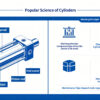
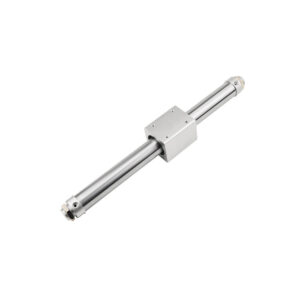
A cylinder actuator, also known as a pneumatic actuator or pneumatic head, is a device that converts the pressure energy of compressed air into mechanical energy to produce linear, oscillating or rotational motion. Simply put, it relies on compressed air to drive mechanical movements.
Cylinder operating modes are generally divided into single-acting and double-acting types, corresponding to single-acting actuators and double-acting actuators respectively.
Common types include diaphragm type, piston type, and rack-and-pinion type:
a. Diaphragm type: Features a short stroke and low output force with high precision, suitable for the control of small-diameter valves.
b. Piston type: Features a long stroke and large output force, ideal for working conditions with large-diameter valves and high pressure differences.
c. Rack-and-pinion type: Adopts a compact structure with stable operation. It converts the linear motion of the piston into rotational motion and is widely used for controlling butterfly valves and ball valves.
Normally Closed Type (Single Acting)
Air pressurization: Air pressure overcomes spring force to open the valve.
Air exhaust: The spring automatically resets to close the valve.
Normally Closed Type Working Principle (Single Acting)
Air supply status: Air pressure overcomes the spring force to open the valve.
Air cut-off status: The spring resets automatically to close the valve.
3.Solenoid Valve

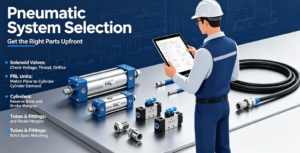
Solenoid valves are fundamental automated components that regulate fluid via electromagnetic force, controlling the on-off status and flow direction of compressed air within pneumatic systems.
Inside a solenoid valve lies an airtight chamber with a movable spool at its center and electromagnets mounted on both sides. When the coil is energized, electromagnetic force pulls the spool to shift and switch the air circuit direction; upon power cut-off, spring tension returns the spool to its original position.
Notes for Model Selection
a. Voltage: AC220V or DC24V is preferred for easy matching with peripheral equipment.
b. Normally Open / Normally Closed: Select NO type for long-duration continuous opening; choose NC type for frequent on-off operation.
c. Explosion-proof requirement: Explosion-proof solenoid valves are mandatory for hazardous explosive atmospheres.
4.Filter Regulator

Filter Regulator (also known as Filter Pressure Reducing Valve, one component of FRL air source treatment unit) is a pneumatic component integrating an air filter and a pressure regulator into a single compact assembly. It fulfills two core functions:
a. Remove moisture, dust and oil mist contained in compressed air;
b. Stabilize inlet pressure to the preset value required by downstream equipment.
Why is a Filter Regulator necessary?
a. Contaminants such as moisture, rust debris and oil mist inside compressed air will accelerate abrasion of cylinder seals, block pilot orifices of solenoid valves, and corrode pipelines and equipment;
b. Pressure fluctuation impairs the stability of cylinder output force and operational precision.
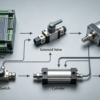
Relationship among the three parts: A complete control circuit consists of air compressor → filter regulator → solenoid valve → cylinder actuator → mechanical equipment.
Comprehensive Guide to Pneumatic Actuators | Become an Expert in Seconds

Add comment