

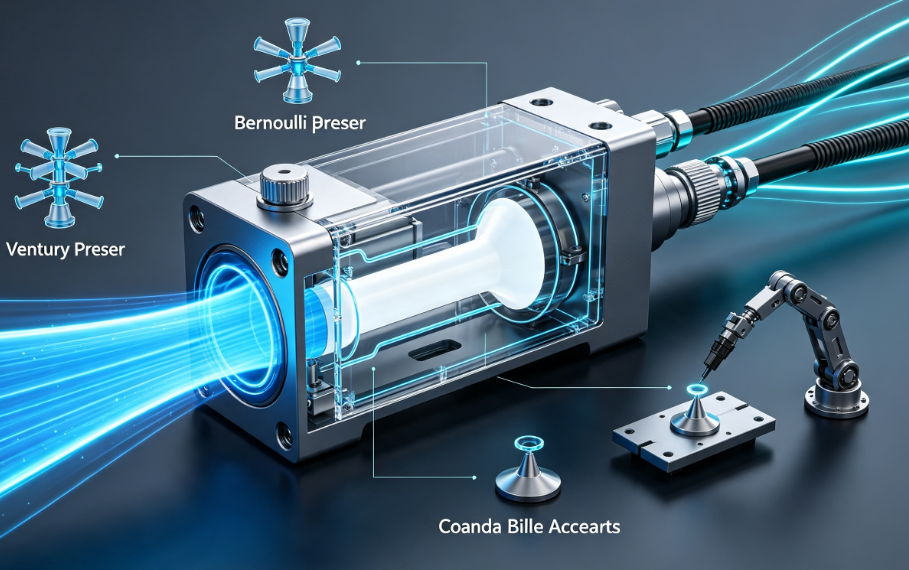
Venturi vacuum generator, Bernoulli vacuum gripper, Coanda effect vacuum generator, pneumatic vacuum ejector
Working Principle of Vacuum Generator
Table of Contents
- Working Principles of Three Types of Vacuum Generators
- 1.Venturi Principle
- 2.Bernoulli Principle
- 3.Coanda Principle
Essentially, a vacuum generator is an innovative, high-efficiency, clean, cost-effective and compact vacuum component that generates negative pressure using a positive pressure air source. Thanks to its unique working principle, it enables easy and convenient acquisition of negative pressure wherever compressed air is available. In addition, it also works perfectly within pneumatic systems that require both positive and negative pressure to operate simultaneously.
Vacuum generators are widely adopted across a wealth of industrial automation sectors, covering machinery, electronics, packaging, printing, plastics and robotics industries. In practical industrial scenarios, they are conventionally paired with vacuum suction cups to grip and transfer various materials. Furthermore, they prove particularly ideal for handling fragile, soft, thin non-ferrous and non-metallic materials, as well as spherical objects. Notably, such application scenarios share several typical common characteristics: specifically low required pumping flow, moderate vacuum level demand and intermittent operating mode.
Working Principles of Three Types of Vacuum Generators
1.Venturi Principle
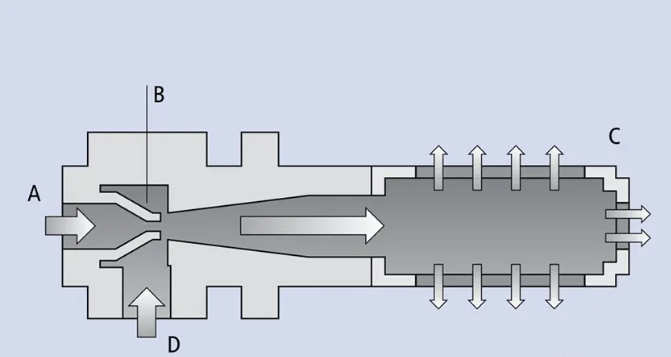
Pneumatic vacuum generators operate on the Venturi principle. Compressed air enters the vacuum generator (A). As the cross-section of the power nozzle (Venturi nozzle [B]) narrows, the flow velocity of compressed air rises, leading to increased dynamic pressure and reduced static air pressure. After passing through the power nozzle, the accelerated air expands and creates a vacuum. Ambient air is drawn into the vacuum generator via the vacuum port (D). The compressed air mixes with the intake air and exhausts through the silencer (C).
Advantages
Outstanding performance under high acceleration conditions
Independent control of vacuum suction units
Dedicated models available for centralized and decentralized vacuum systems to suit diverse applications
Multiple power ratings compatible with different workpieces and scenarios
Application
Universal suitability for all kinds of vacuum systems
2.Bernoulli Principle
Working Principle
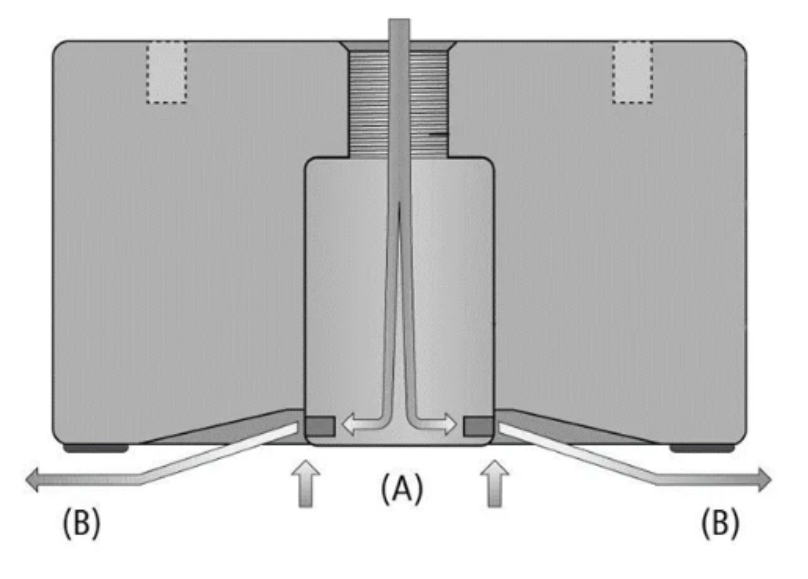
Pneumatic operation is realized with a built-in vacuum generator. Compressed air discharges through multiple orifices on the suction cup with drastically increased flow velocity. Rising flow velocity reduces static pressure and forms a vacuum (A), which follows the Bernoulli equation. The high-speed air exhausts sideways (B), forming an air cushion between the levitating vacuum suction cup and the workpiece. High flow velocity compensates air leakage, allowing handling and separation of porous workpieces. Workpiece transfer can be achieved with nearly zero contact thanks to the Bernoulli effect. Levitating vacuum suction cups function based on this principle.
Advantages
Gentle handling of ultra-thin and highly sensitive workpieces with minimal contact
Reliable separation of thin and porous materials
Application
Transfer of ultra-thin, highly sensitive or highly permeable workpieces
3.Coanda Principle
Working Principle
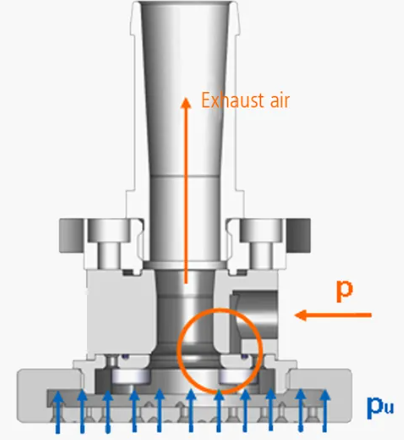
Built-in vacuum generators support pneumatic actuation. In accordance with the Coanda principle, compressed air flows through an annular gap to accelerate airflow, triggering the Coanda effect. Exhaust air adheres to the curved surface of the protruding component. The air flowing along the surface produces suction force in surrounding air via entrainment.
Advantages
High adsorption speed and low air consumption (operating pressure only 1–5 bar)
Large contact area paired with narrow vacuum openings to avoid workpiece sticking or damage
Partial localization of adsorption zones is achievable
Application
Suitable for handling flat panels, thin sheets and lightweight workpieces
Working Principle of Vacuum Generator


Add comment